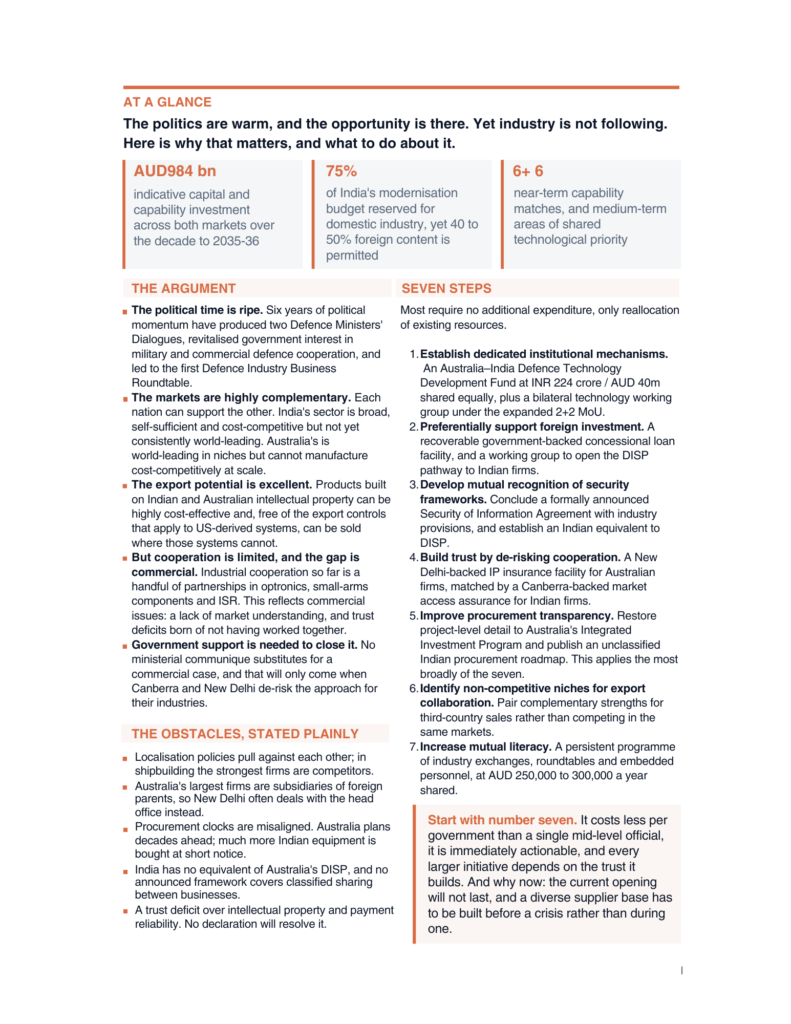
The India–Australia defence relationship has never been politically warmer. Industry has not followed. Since the elevation of the bilateral relationship to a Comprehensive Strategic Partnership in 2020, the two countries have substantially expanded military cooperation, including in exercises and information sharing, convened two Defence Ministers’ Dialogues and held the first Defence Industry Business Roundtable. What industry has built is a handful of partnerships in optronics, small-arms components and ISR systems. This report argues that the gap is commercial before it is political, and that it will close only when cooperation makes money for firms on both sides.
The case rests on complementarity. India’s defence sector is largely self-sufficient but not yet consistently world-leading; Australia’s is often world-leading but cannot manufacture cost competitively at scale. Each nation has what the other needs, and products built on natively Indian and Australian intellectual property escape the reach of United States (US) export controls in a way that US-derived systems cannot. Further, uncontested lines of communication between them allow Delhi to support Canberra, and vice versa, with a minimised risk of strategic interference. Against this sit competing indigenisation mandates, Australian primes owned by foreign parents, misaligned procurement timelines and a trust deficit that no ministerial communiqué will resolve. The report states these plainly.
Drawing on verified procurement records, budget documents and industry data from both countries, the analysis identifies near-term matches between documented Indian requirements and established Australian capabilities, six medium-term areas of shared technological priority, and the structural obstacles standing between them. It closes with seven initiatives with indicative costs, most of which require no direct expenditure.