
India isn’t the freeloader the US makes it out to be

The US takes India’s brightest students, trained in our best institutions that are often subsidised, charges them hefty fees, and keeps the smartest.
Extracting the Gains: Why India Must Negotiate Harder in the Data Center Boom

The report does three things. It maps the market and policy drivers of the boom, including domestic demand, the GCC ecosystem, infrastructure status for data centers above 5 MW, a twenty-year tax holiday for foreign hyperscalers exporting their services, state-level incentive packages, and a dense maze of data localization rules. It then conducts a cost-benefit analysis that questions the dominant claims of technological sovereignty and broad economic gain. Finally, it argues that India must shift from investment facilitation to negotiated extraction, and lays out the concrete templates the government can put on the table: compute for academia, applied R&D testbeds, regional tech clusters, AI-based public service delivery, and a structured renewables and storage push.
Unlocking India-Canada Bilateral Trade: A Provincial Framework for a Successful CEPA

Canada’s relationship with India is often told as a single national story. This report argues it is ten stories at once. It examines how Canada’s provinces, each with a distinct industrial base, resource endowment, and set of India-facing opportunities, are quietly driving one of the most consequential bilateral relationships of the coming decade.
Toward a Trilateral Tech Framework: Connecting India, Japan, and South Korea in the Indo-Pacific
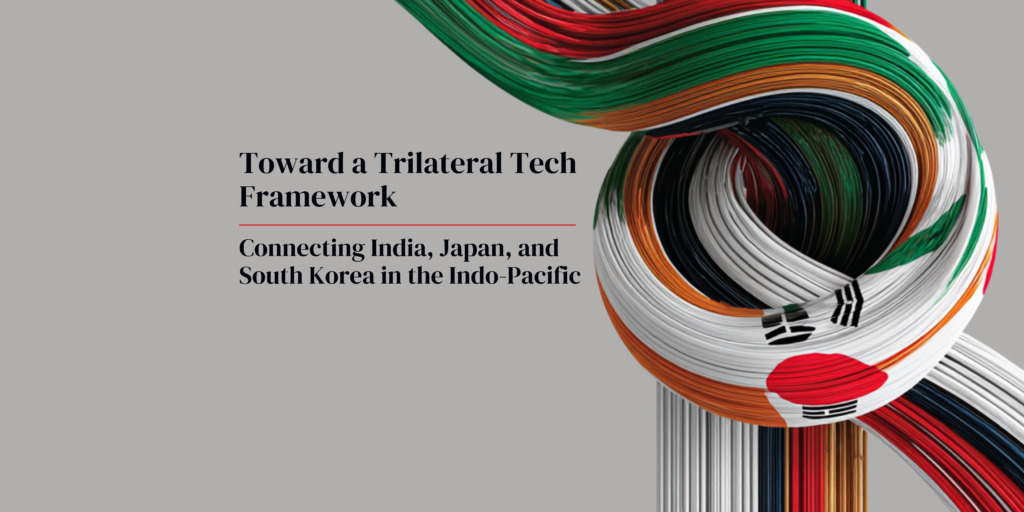
This report examines a conspicuous gap in Indo-Pacific architecture: the absence of a formalized mechanism for technology cooperation among three of Asia’s leading democracies. Against the backdrop of intensifying US-China rivalry, erratic American trade policy under Trump 2.0, and China’s weaponization of economic interdependence, the report makes a compelling case for a purpose-built minilateral that leverages complementary national strengths — India’s digital economy and human capital, Japan’s precision manufacturing and standards diplomacy, and South Korea’s semiconductor and electronics leadership.