Maritime Domain Awareness in the Indo-Pacific: National Approaches, Regional Gaps, and Opportunities for Collaboration

This workshop advanced discussions on Maritime Domain Awareness in the Indo-Pacific, focusing on national approaches, regional gaps, information-sharing, interoperability, and commercial earth-observation capabilities. Bringing together policy experts, maritime practitioners, and technology providers, it explored practical opportunities for data-sharing, capacity building, technological collaboration, and stronger regional coordination.
Korea Chair Bulletin: August-September 2026

The Korea Chair Bulletin provides research-driven insights into India-South Korea relations, covering policy shifts, strategic dialogues, and emerging trends. It also highlights key developments and news from the Korean Peninsula.
Australia-India Anti-Submarine Warfare (ASW) Cooperation: Doctrine, Capabilities, Constraints, and Strategic Futures
This report examines Australia–India anti-submarine warfare (ASW) cooperation within an increasingly contested Indo-Pacific undersea environment. It argues that meaningful, campaign-level cooperation is both achievable and strategically valuable without requiring alliance-style integration or the sharing of highly sensitive sensor architectures. Cooperation is best structured around aligned doctrine, greater intelligence sharing, and routine operational coordination that builds the enduring relationships between the two operational-level headquarters.
The Illusion of Technology Transfer: The Missing Ingredients of India’s Defense Industrialization
India has built foreign-designed weapons under license for six decades without acquiring design authority. This report explains why: procurement treats technology transfer as a contractual deliverable, but absorption cannot be contracted for. It sets out a ladder of technological depth and a five-stage chain, then scores four programs against them.
Abhimanthan
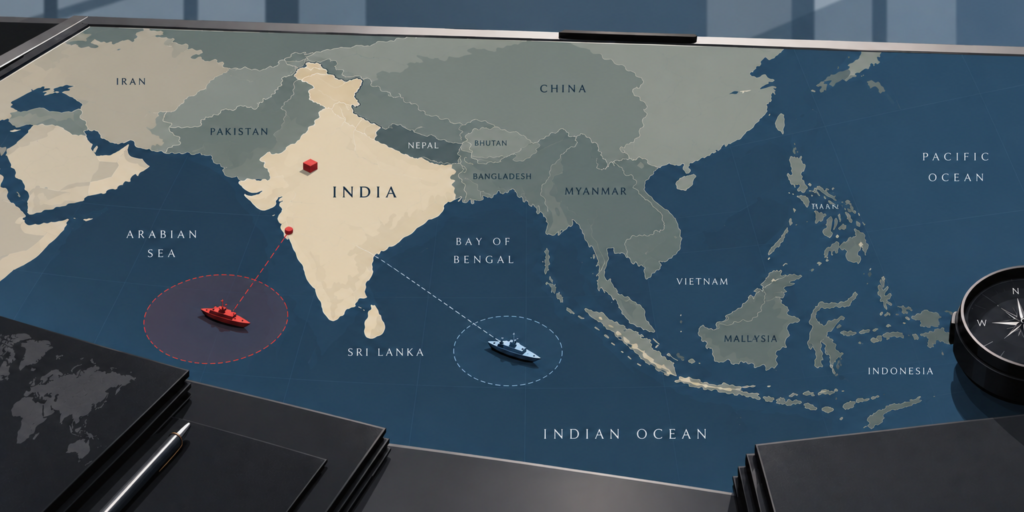
As part of the 4th Future Warfare Course, CSDR hosted a wargame designed by Dr. Sidharth Raimedhi and Lt. Gen. D. S. Hooda (Retd.) for HQ IDS. The exercise tested strategic decision-making, joint planning, coordination, and capability prioritization in a simulated future warfare environment, followed by a detailed debrief.
India must catch up in this China-US tech race

This contest is not about who unveils the cleverest AI model. It is about building the most effective ecosystem connecting universities, laboratories, entrepreneurs, finance, energy, factories, supply chains and markets