Building Resilience: The India-Canada Critical Minerals Partnership in an Era of Strategic Competition

This report examines India-Canada critical minerals cooperation amid China’s supply chain dominance and weaponization. It analyzes both nations’ regulatory landscapes, strategic vulnerabilities, and partnership opportunities across exploration, processing, and downstream manufacturing. Drawing on policy documents and industry data through December 2025, it provides actionable recommendations for building resilient alternative supply chains.
Constrained Convergence: Operationalizing India-Canada Security and Defense-Industrial Cooperation

This report examines India-Canada defence-industrial cooperation amid geopolitical pressures and the 2023-24 diplomatic rupture. The report maps existing industrial ties, identifies feasible cooperation areas—maritime security, peacekeeping, cybersecurity, critical minerals—while acknowledging structural constraints from export controls and procurement complexities. It offers actionable recommendations for operationalizing partnership within alliance architectures.
Preventing a Sunset in the East: India-Bangladesh Ties After Hasina

Following Sheikh Hasina’s 2024 ouster, India-Bangladesh relations have deteriorated, with political distrust weaponizing trade, border security, and water sharing. Dhaka’s pivot toward Pakistan and China exacerbates security concerns. To prevent permanent damage before the 2026 elections, the report urges New Delhi to diversify engagement and activate “bleeding valve” diplomatic channels.
Korea Chair Bulletin: November-December 2025

The Korea Chair Bulletin provides research-driven insights into India-South Korea relations, covering policy shifts, strategic dialogues, and emerging trends. It also highlights key developments and news from the Korean Peninsula.
Zeitenwende Meets Atmanirbhar: Co-Creating the Future of Indo-German Defense

Indo-German defense ties are at a strategic inflection point. As Germany embraces Zeitenwende and India pursues Atmanirbhar Bharat, this report argues for shifting from transactional arms sales to deep industrial co-creation. It maps a decade-long strategy (2025–2035) to fuse German engineering with Indian manufacturing scale. Key recommendations include a $50M joint innovation fund, fast-tracked export controls (“Green Lists”), and integrating MSMEs into global supply chains. The goal: a resilient partnership building strategic autonomy for both nations.
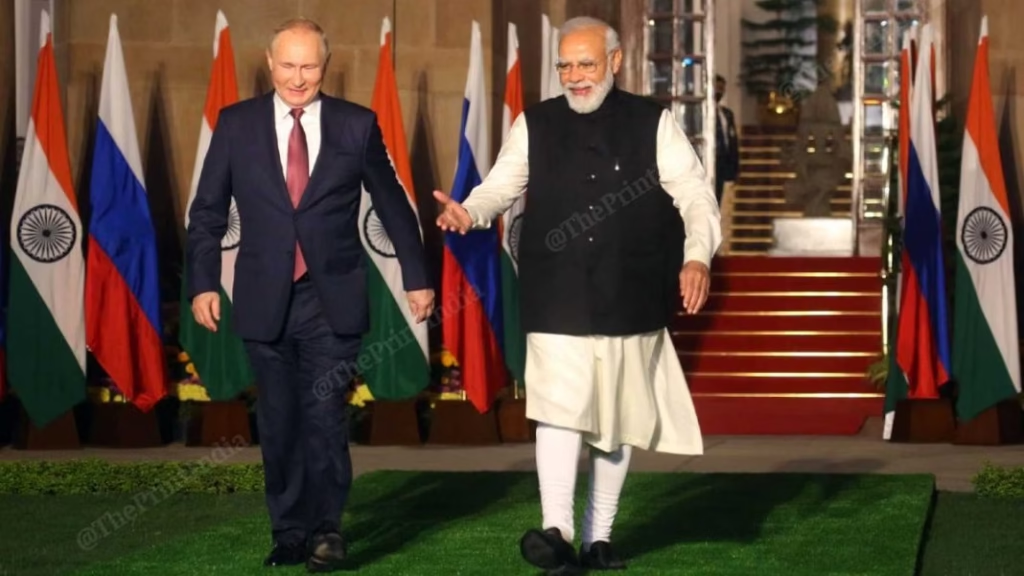
An India-China tango is unlikely at present

There are legitimate questions about the assessment that there are far more convergences than differences between the two countries